
"Trust But Verify.” Ignoring this Discipline Almost Cost Me Everything.
“TRUST BUT VERIFY” is burned into my brain. And the one time I trusted because I had a hard time verifying – it almost cost me everything.
I’ve had a love for numbers since I was a kid. My graduate work focused on REIT securities research, which taught me how to strip a real estate company down to its parts and figure out what the portfolio’s actually worth - independent of what management says it's worth. This value is known as “Net Asset Value.” NAV Analysis is one of the sharpest tools in the alternative investment toolbox.
When friends ask me about REIT securities – I can likely point out a winner, or at the very least explain why I think one is not.
In July 2019, I was evaluating the execution of a tender offer on a non-traded REIT (NTR) in the secondaries market. The secondaries market is where shares of publicly-registered, but non-traded companies exchange hands. These firms are not actively traded on the NASDAQ or NYSE, but they also avoid the high costs of SEC compliance and quarterly reporting pressures.
Some NTRs only need to update their NAV once per year, generally at year-end. Given it was July, seven months after the portfolio’s last NAV update, I knew I had to scrutinize the financials even further because the NAV was stale.
This particular fund's December 2016 NAV was $4.89/share. My own top-down analysis (analyzing the trends in the quarterly cash flow statements) and bottom-up analysis (analyzing the portfolio of real estate assets) kept returning $3.67/share, which was 25% below the fund’s stated NAV.
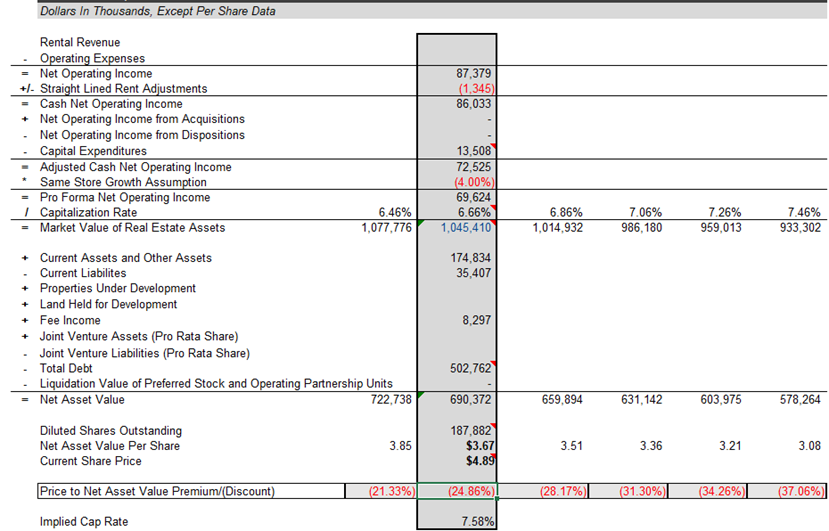
Top-Down NAV Calculation
In tender offers, companies approach existing shareholders directly, offer to buy their illiquid shares at a discount to the fund's stated value (the NAV), then hold those shares until the fund liquidates – or find a quicker exit path through another group on the secondaries market. The spread between what we pay and what we ultimately collect is our profit window.
My NAV on this particular company was falling materially short of the REIT’s guidance – so I called a friend (he’s a genius, a real estate entrepreneur, and someone I generally receive solid real estate market advice from). He suggested cap rates for this asset type in their respective locations were strong and traded closer to 5.50%, not 6.66% as I had calculated.
I ran the revised model, and Boom – I got my NAV to $4.85/share. It checked out. We ran the tender at $3.00/share, thinking it was a healthy 39% discount to NAV.
The tender was a huge success…Success that was almost too good, to the point where I wondered if the tendering shareholders knew something I didn’t…
Two months later, another firm ran a tender at $3.61/share. Our all-in basis (offered share price + tender costs + liquidity discount) was roughly $3.45/share.
We begrudgingly dumped our allotment shares to that firm, earning a slim $0.16/share gross profit margin. The original plan was to hold until liquidation.

I was disappointed, thinking the shares we purchased could have earned us closer to $1.5MM in gross profit. Now we were selling for a fraction of that.
November 2019 rolled around, and the company updated their NAV to $3.79/share. A massive decrease – and just 3.2% off my original calculation!
Looking back – had we not tendered our shares to the higher buyer, our fund could have been completely wiped out.
My first instinct was right. I overrode it based on a single phone call instead of continuing to verify. My friend wasn’t wrong, and it wasn’t his fault. The REIT wasn’t wrong – their stated NAV was well within the rules.
It was my mistake - and I had to own it. Besides, the market was already telling me something through unusually strong tender participation. And I almost didn't listen.
But the lesson is not about being right or wrong. It's about maintaining discipline when the numbers and your research are trying to tell you something and a trusted voice is offering an alternative view.
To this day – I trust but verify everything. If I’m not 100% convinced, I’m not done verifying yet.